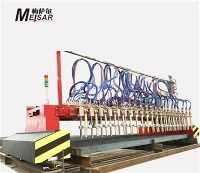
Industrial CNC Steel Plate and Profile Cutting Machines
Heavy-duty CNC cutting systems engineered for precision profile cutting, beveling, and heavy plate processing in structural steel, shipbuilding, and equipment manufacturing.
Product Specifications & Performance Metrics
Designed to process carbon steel, stainless steel, and aluminum plates ranging from 6mm to 150mm in thickness, built with a stress-relieved welded steel gantry and dual-side AC servo drives to maintain dimensional stability across multi-shift operations.
|
Technical Parameter |
Standard Specification |
Heavy-Duty Option |
|
Effective Cutting Width |
2,000 mm - 4,000 mm |
Up to 6,000 mm |
|
Effective Cutting Length |
6,000 mm - 12,000 mm |
Customized up to 24,000 mm |
|
Drive System |
AC Brushless Servo Motors + Planetary Gearboxes |
Dual-side Helical Rack & Pinion |
|
Positioning Accuracy |
plus/minus 0.1 mm / m |
plus/minus 0.05 mm / m |
|
Max Rapid Traverse Speed |
20,000 mm/min |
30,000 mm/min |
|
Cutting Technologies |
Oxy-Fuel, High-Definition Plasma |
5-Axis Bevel Head, Fiber Laser Integration |
Core Manufacturing Standards & Engineering Evidence
Gantry Structure: Box-type welded steel construction, annealed at 600 degrees Celsius in a large-scale furnace to eliminate internal residual stress, preventing thermal distortion over years of continuous operation.
Precision Machining: All gantry beam mating surfaces are milled on a 20-meter CNC floor boring machine in a single setup to guarantee parallelism and straightness within 0.05mm.
Motion Control & Height Sensing: Integrated with industrial CNC controllers (Hypertherm EDGE Connect or Burny 10LCD) supporting ISO G-code and automatic nesting software. Features capacitive and arc-voltage Torch Height Control (THC) for consistent stand-off distance.
Electrical Compliance: Control cabinets adhere to NFPA 79 standards, using numbered terminal blocks, shielded cables to prevent high-frequency plasma interference, and industrial-grade Schneider/Siemens switchgear.
Factory Acceptance Testing (FAT): Every system undergoes a 72-hour dry-run test, laser interferometer calibration for positioning accuracy, and a live test cut to verify squareness and diagonal tolerances before crating.
Technology Selection Guide: Plasma vs. Laser vs. Oxy-Fuel
Selecting the right thermal cutting technology dictates operating cost per meter and subsequent welding preparation time. Use this evaluation matrix to align equipment specifications with your shop-floor requirements:
|
Evaluation Metric |
High-Definition Plasma Cutting |
Fiber Laser Cutting (15kW-30kW) |
Oxy-Fuel Cutting |
|
Optimal Carbon Steel Range |
6 mm - 50 mm (Severance up to 80mm+) |
6 mm - 35 mm |
50 mm - 200 mm+ |
|
Capital Investment Cost |
Medium |
High |
Low to Medium |
|
Operating Cost (Consumables) |
Moderate |
Low (High electrical efficiency) |
Low (Oxygen & Propane) |
|
Cutting Speed (20mm Steel) |
Approx. 2,200 mm/min |
Approx. 1,800 mm/min |
Approx. 400 mm/min |
|
Edge Squareness & Angularity |
ISO 9013 Range 2 to 3 |
ISO 9013 Range 1 to 2 |
ISO 9013 Range 3 to 4 |
Engineering Selection Criteria for Heavy Plates:
• Under 25mm: Fiber lasers deliver high speed and narrow kerf width for thin-to-medium parts.
• 25mm to 80mm: High-definition plasma (such as Hypertherm XPR systems) provides the optimal balance of pierce capability, edge quality, and lower capital outlay.
• Over 80mm: Oxy-fuel remains the definitive choice for ultra-thick structural plates and pressure vessel components.
Application Scenarios
Structural Steel Fabrication:
Cutting connection gussets, base plates, and structural nodes for high-rise buildings and bridge infrastructure.
Shipbuilding & Marine Engineering:
Processing large-format hull plates, web frames, and longitudinal stiffener profiles.
Construction Machinery:
Fabricating thick-plate chassis components, boom arms, and excavator buckets from high-strength structural steels (e.g., Hardox/Weldox grades).
Pressure Vessel Manufacturing:
Edge preparation and contour cutting for tank shells and dished heads.
Frequently Asked Questions (FAQ)
Q: What is the maximum plate thickness supported by plasma versus oxy-fuel on this machine?
A: High-definition plasma systems cleanly pierce and cut carbon steel up to 50mm, with a severance capacity of 80mm. For plates exceeding 80mm up to 200mm, the machine integrates multi-torch oxy-fuel stations with automatic electronic ignition.
Q: How is thermal distortion minimized during continuous high-speed cutting?
A: The cutting table utilizes a compartmentalized downdraft zoning design with pneumatic dampers that open only beneath the active cutting area. This isolates heat, extracts fumes efficiently, and protects the structural support slats from warping.
Q: Can the machine perform bevel cutting for subsequent welding preparation?
A: Yes. The system can be configured with a 5-axis dynamic bevel cutting head (supporting V, Y, X, and K bevels) or a pneumatic tilt oxy-fuel bevel torch, maintaining up to 45 degrees rotation angles for direct weld-prep profiling.
Q: What CAD/CAM nesting software is compatible with the CNC controller?
A: The controller natively imports standard .DXF and .DWG files and integrates seamlessly with third-party nesting software such as ProNest, SigmaNEST, and FastCAM to optimize material utilization and generate toolpaths.
Q: What are the electrical and utility requirements for installation?
A: Standard input power is 3-Phase 380V/480V, 50/60Hz. Plasma configurations require clean, dry shop air at 0.6 to 0.8 MPa and appropriate industrial cutting gases (Oxygen, Nitrogen, Argon-Hydrogen) with specified flow rates provided in our pre-installation guide.
Hot Tags: cnc steel plate and profile cutting machine, China cnc steel plate and profile cutting machine manufacturers, suppliers, factory