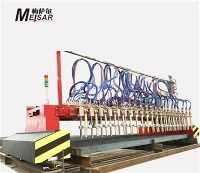
CNC Plate and Angle Steel Combined Processing Line for Structural Fabrication
The CNC Plate and Angle Steel Combined Processing Line is engineered for high-volume structural steel fabricators requiring automated shearing, punching, and thermal cutting. By reading CAD/CAM data directly from structural detailing software (such as Tekla Structures), this machine eliminates manual layout and reduces material handling between production stations.
Core Technical Specifications
|
Parameter Category |
Specification Details |
|
Angle Steel Processing Capacity |
Up to 200 x 200 x 20 mm |
|
Plate Processing Dimensions |
Max Width: 1500 mm, Thickness: 6 to 25 mm |
|
Punching Force |
1000 kN to 2500 kN (Hydraulic actuation) |
|
Positioning Accuracy |
plus or minus 0.15 mm |
|
Max Feeding Speed |
40 m/min via servo-driven rack and pinion |
|
Supported Formats |
DSTV, DXF, DWG (Direct import from CAD/CAM) |
|
Electrical Compliance |
UL/CSA certified control panels (North American market); CE standard (European market) |
Product Selection Guide: Matching Your Production Volume
Selecting the correct machine configuration depends on your primary output ratio between angle profiles and flat plates.
Low-to-Medium Volume (Tower Shops): Choose single-station angle punching and shearing units combined with standalone CNC plasma/oxy-fuel plate cutters. Ideal for job shops processing under 50 tons per week.
High-Volume Continuous Production (Utility & Infrastructure OEM): Select fully integrated CNC combined lines featuring automatic angle loading magazines, multi-punch die heads, and high-speed hydraulic shearers coupled with CNC plate drilling/cutting gantries.
Application & Material Suitability
Engineered for continuous multi-shift operation in heavy fabrication environments, conforming to international safety and structural standards.
Power Transmission & Telecom Towers: High-precision hole punching and length cutting for angle iron legs and bracing members.
Steel Structure Buildings: Gusset plates, base plates, and connection nodes machined from carbon structural steel (ASTM A36, S355JR, Q355).
Bridge & Highway Infrastructure: Heavy-duty angle profiles and thick connection plates processed to tight structural tolerances.
Supplier Evaluation Criteria
When vetting manufacturers for heavy structural machinery, verify the following baseline manufacturing processes:
Machine Rigidity:
Ensure the main frame is fabricated from heavy-walled structural steel tubing, fully annealed in a gas-fired furnace to relieve internal welding stresses prior to precision CNC boring and milling.
Hydraulic & Pneumatic Integrity:
Verify the use of industry-standard hydraulic valves and pumps (e.g., Bosch Rexroth or Parker) to eliminate pressure drops during simultaneous punching and clamping cycles.
Control System Reliability:
Industrial-grade CNC controllers (Siemens or Fanuc) operating on closed-loop absolute servo feedback loops rather than open-loop stepper motors.
Testing Standards:
Insist on factory acceptance testing (FAT) logs showing actual dimensional verification on test coupons and compliance with regional directives (CE or OSHA-aligned safety enclosures) prior to container loading.
Procurement Decision & Quotation Checklist
To accelerate your technical evaluation and secure an accurate quotation, prepare the following parameters for our engineering team:
• Maximum cross-section dimensions and minimum thickness of your standard angle steel inventory.
• Maximum plate dimensions, thickness range, and material grades (e.g., ASTM A36, S355).
• Required hole diameters, punching patterns, and edge distance tolerances.
• Regional electrical grid requirements (e.g., North American 460V/60Hz with UL panels or European 400V/50Hz with CE).
• Expected weekly or monthly tonnage output to determine the required automation level.
Frequently Asked Questions (FAQ)
Q: How does the machine handle warped or curved raw angle steel profiles?
A: The system utilizes hydraulic vertical and horizontal clamping cylinders along the infeed conveyor to flatten and register angle steel against positioning datums before punching or shearing begins, ensuring hole-to-end tolerances remain within plus or minus 0.5 mm.
Q: Can the CNC system import DSTV files directly from Tekla Structures?
A: Yes. The control software includes a built-in post-processor that reads standard DSTV files generated by Tekla, SDS/2, and AutoCAD. It automatically extracts nesting layouts, hole coordinates, and cut lengths without manual reprogramming.
Q: What is the typical tool change time for punching dies?
A: The machine features a quick-change punch and die retainer design. Operators can swap out round or slotted punches within 3 to 5 minutes per station using standard manual hand tools, minimizing setup downtime between different project batches.
Q: What maintenance schedule is required for continuous dual-shift operation?
A: Daily maintenance includes checking hydraulic oil temperatures, inspecting pneumatic lubricators, and clearing scrap slugs from the shear chute. Weekly tasks involve greasing linear guideways and ball screws using high-temperature lithium-based grease.
Q: What are the standard electrical and regional compliance options available?
A: The standard power configuration is 3-phase, 380V/415V, 50Hz/60Hz, with custom configurations available for North American 460V grids utilizing UL-listed electrical components. Compressed air requirement is 0.6 to 0.8 MPa at a continuous flow rate of 0.5 cubic meters per minute to support pneumatic clamping and auxiliary functions.
Hot Tags: cnc plate and angle steel cutting machine, China cnc plate and angle steel cutting machine manufacturers, suppliers, factory