


CNC Pipe Hole & Intersection Cutting Machines
Model Selection Guide for Shop Floor Integration
Model 400 Series (Mechanical & HVAC Skids): Configured for small-to-medium structural tubing and pipe headers. Utilizes a 3-jaw self-centering chuck to eliminate pipe slippage during high-speed rotational profiling.
Model 800 Series (Petrochemical & Boiler Fabrication): Handles thick-wall carbon steel pipes up to 800 mm OD. Supports variable bevel angles (V, Y, and K joint preparations) up to ±45° for high-pressure welding compliance.
Model 1400+ Series (Offshore Structures & Infrastructure): Built on a heavy-load friction-roller bed configuration to support massive pipe weights without distorting rotation speed. Equipped with a 6th V-axis to adjust radial torch positioning independently of pipe rotation.
-
 CNC Plasma Pipe Hole Cutting MachineIndustrial-grade automated cutting system engineered for structural steel pipe intersections, saddle cuts, and weld-ready beveling. Designed for heavy fabrication shops requiring high dimensionalAdd to Inquiry
-
 CNC Multi-Axis Pipe Intersection Cutting MachineThe CNC Multi-Axis Pipe Intersection Cutting Machine is engineered for structural steel fabricators and pressure vessel manufacturers requiring high-precision profile cutting, saddle cuts, andAdd to Inquiry
-
 CNC Pipe Branch Hole Cutting MachineThe CNC Pipe Branch Hole Cutting Machine executes automated profile cutting of saddle, intersection, and branch holes on main run pipes. Multi-axis simultaneous interpolation coordinates rotation,Add to Inquiry
-
 CNC Pipe Profile Cutting MachineHeavy structural steel fabrication and pressure vessel manufacturing require repeatable, code-compliant weld preparation on tubular nodes. This CNC Pipe Profile Cutting Machine utilizes multi-axisAdd to Inquiry
-
 CNC Pipe Intersection Cutting MachineDual-end synchronized AC servo motors coupled with planetary gearboxes on the rotation axis; zero-backlash linear rail guides on the longitudinal carriage.Add to Inquiry
-
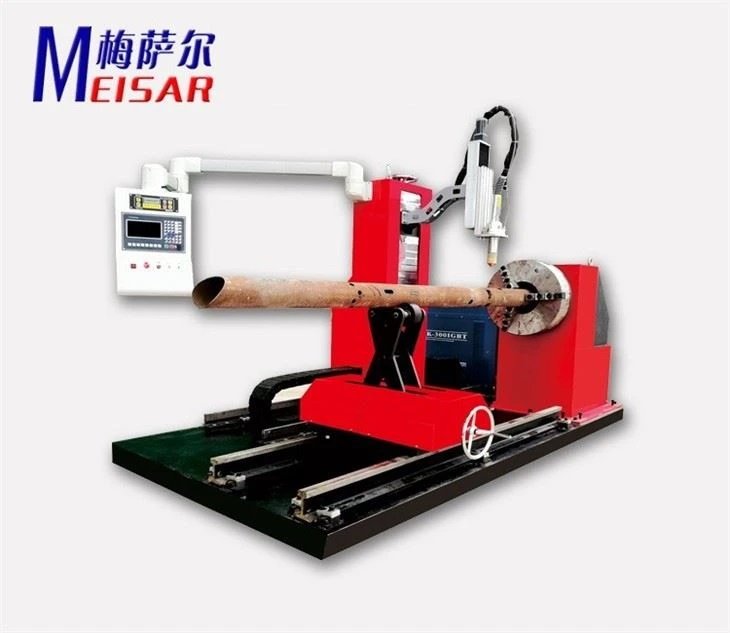
 CNC Pipe Hole Cutting MachineThe CNC Pipe Hole Cutting Machine automates the profiling, contouring, and hole-cutting processes on carbon steel, stainless steel, and alloy pipes. Built for high-throughput fabrication facilities,Add to Inquiry



Technical Specifications & Axis Configurations
Multi-axis CNC architecture controls coordinated motion between the pipe chuck rotation and the thermal cutting torch, executing saddle joints, miters, and lateral hole cutouts in a single pass.
|
Specification |
Model 400 (4-Axis) |
Model 800 (5-Axis) |
Model 1400 (6-Axis) |
|
Pipe Outer Diameter (OD) |
Φ 60 mm – 400 mm |
Φ 100 mm – 800 mm |
Φ 200 mm – 1400 mm |
|
Standard Pipe Length |
Up to 6000 mm |
Up to 12000 mm |
Up to 12000 mm+ |
|
Wall Thickness Capacity |
Plasma: 3 mm – 25 mm |
Plasma: 3 mm – 35 mm |
Flame: Up to 100 mm |
|
Interpolated Motion Axes |
X (Longitudinal), Y (Rotation), Z (Torch Up/Down), A (Torch Beveling) |
Adds B-axis (Longitudinal torch tilt) |
Adds V-axis (Radial torch slide for heavy loads) |
|
Linear Positioning Accuracy |
± 0.1 mm per 1000 mm |
± 0.1 mm per 1000 mm |
± 0.15 mm per 1000 mm |
|
Thermal Cutting Media |
Fine-feature Air/Oxygen Plasma |
High-Current Plasma / Oxy-fuel Dual Option |
Heavy-Duty Oxy-fuel / High-Density Plasma |
Processed Joint Geometries
• Saddle intersections (T-, K-, and Y-branch connections)
• Straight and compound miter cuts for lobster-back bends
• Eccentric and concentric hole cutouts on main pipe surfaces
• Square, rectangular, and shaped profile end cuts
• Weld preparation beveling (0° to 45° continuous contour)
Material Grades
• Carbon Steel: API 5L (Grades B through X80), ASTM A53, A106.
• Stainless Steel: Austenitic grades (304/304L, 316/316L) utilizing high-definition plasma parameters to minimize dross accumulation.
• Alloy Steels: Chrome-moly pressure piping (P91, P22).
Mechanical Build Quality & Manufacturing Standards
Bed Chassis:
Fabricated from heavy structural steel tubing and plates, annealed at 600°C in a gas-fired furnace to eliminate residual internal welding stresses before CNC gantry milling.
Drive Train:
Driven by Panasonic AC digital servo motors coupled directly to zero-backlash planetary gearboxes. Rack-and-pinion transmission utilizes hardened and ground helical teeth for smooth axial tracking.
Torch Height Control (THC):
Integrated capacitive and arc-voltage feedback loops adjust the Z-axis in real time, compensating for pipe ovality and surface runout.
Factory Inspection Routine:
Systems undergo a 72-hour continuous dry-run burn-in test, laser interferometer calibration for perpendicularity alignment, and a physical test-cut verification on a 610 mm carbon steel workpiece before factory release.
Software & CAD/CAM Data Workflow
File Import:
Directly reads .DSTV, .STEP, and .IGES files exported from structural detailing software such as Tekla Structures and Advance Steel.
Parametric Nesting:
Built-in macro library contains over 30 parametric joint configurations. Operators enter pipe outer diameter, wall thickness, and intersection angle directly at the industrial console for instant code generation.
Console Hardware:
Industrial PC controller featuring a 19-inch multi-touch interface, enclosed in an IP54-rated cabinet protected against conductive metal dust and thermal radiation.
Procurement & Supplier Evaluation Metrics
When auditing fabrication machine builders for capital expenditure (CapEx) approval, confirm the following technical benchmarks:
In-House Machining Control: Verify that the supplier performs structural bed annealing and gantry milling internally rather than outsourcing heavy structural fabrication.
Component Bill of Materials: Check that motion controllers, servo drives, and gear reducers originate from established industrial tier-1 suppliers (e.g., Panasonic, Yaskawa, Hypertherm, or Schneider).
Diagnostic Portals: Ensure the CNC console includes an Ethernet gateway for remote oscilloscope tracing and application software updates by factory service engineers.
Documentation Deliverables: Standard supply must include full electrical schematics, PLC backup files, mechanical assembly drawings, and ISO/CE compliance certification.
Frequently Asked Questions
We're well-known as one of the leading cnc pipe hole & intersection cutting machines manufacturers and suppliers in China. We warmly welcome you to buy high quality cnc pipe hole & intersection cutting machines at competitive price from our factory.
