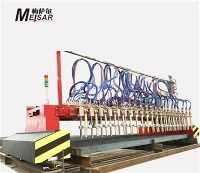
CNC Plate and Structural Channel Steel Cutting Machine: Engineering & Procurement Guide
The CNC Plate and Structural Channel Steel Cutting Machine is engineered for concurrent or dedicated processing of flat steel plates and heavy structural profiles (U-channels, I-beams, and angles) within a single workstation. This dual-function configuration eliminates secondary material transfers, saving critical shop floor footprint, cutting material staging overhead, and maximizing overall capital efficiency.
The machine bed utilizes a heavy-walled structural steel tubular gantry, thermally stress-relieved in a 600 degrees C annealing furnace prior to precision CNC gantry milling. This eliminates internal residual stresses, ensuring structural dimensional stability under heavy dynamic loads up to 3,000 kg.
Technical Specifications Matrix
|
Specification Item |
Standard Configuration |
Optional Upgrade |
|
Plate Cutting Width |
2,000 mm - 4,000 mm |
Custom widths up to 6,000 mm |
|
Channel Steel Size Range |
Web height: 100 mm - 400 mm |
Up to 600 mm structural profiles |
|
Drive System |
Dual-side AC Servo motors with planetary reducers |
Absolute encoder closed-loop feedback |
|
Height Control (THC) |
Capacitive/Arc Voltage Automatic Torch Height Control |
Collision-resistant magnetic breakaway mount |
|
CNC Controller |
Industrial PC-based (Hypertherm Edge Connect / Burny 10) |
Multi-axis interpolated motion controller |
|
Cutting Process |
High-definition Plasma + Oxy-fuel Torch Station |
Fiber Laser cutting head integration |
Model Selection Guide
Selecting the appropriate machine variant relies on material thickness distribution, batch volume, and available plant infrastructure.
Model CS-2040 (General Fabrication):
• Target Application: Structural job shops processing plates up to 50 mm and standard channels up to 300 mm.
• Configuration: Single-side longitudinal drive with high-torque servo motors and precision helical racks.
Model CH-3060 (Heavy Infrastructure & Shipbuilding):
• Target Application: Continuous multi-shift manufacturing of bridge components and heavy chassis frames, handling plates up to 150 mm (oxy-fuel) and structural channels up to 450 mm.
• Configuration: Dual-side synchronized AC servo drives with precision ground linear guides.
Application & Material Compatibility
Structural Steel & Construction: Processing web cutouts, cope cuts, and bolt clearance holes on structural members for seismic-rated frameworks.
Shipbuilding & Marine Engineering: Nesting and cutting complex bracket plates and stiffener profiles simultaneously from carbon steel stock.
Commercial Vehicle Chassis: Fabricating longitudinal frame rails and cross-members from high-yield structural grades (e.g., Q345B, S355JR, ASTM A572).
Manufacturing Process & Quality Control
Weldment Fabrication:
Frames are welded from thick-walled rectangular carbon steel tubing, reinforced with internal web plates to resist structural deflection under rapid traverse.
Thermal Stress Relieving:
Complete gantry assemblies and rail foundations undergo controlled high-temperature furnace cycles to prevent long-term geometric distortion.
Precision Machining:
Linear rail mounting surfaces are milled in a single referencing setup on a large-scale gantry milling center, maintaining parallelism within 0.05 mm per 3,000 mm span.
Metrology & Calibration:
Laser interferometers measure positioning accuracy, backlash compensation, and repeatability across all axes prior to crating and export.
Supplier Evaluation Criteria
Manufacturing Infrastructure: Direct-factory evaluation supported by in-house heavy machining centers and structural annealing facilities.
Component Transparency: Utilization of tier-one global sub-assemblies (Hypertherm plasma systems, Yaskawa/Panasonic servo drives, PMI/Hiwin linear bearings).
Factory Acceptance Testing (FAT): Execution of pre-shipment trial cuts using the buyer's proprietary CAD/CAM files and raw material samples, fully documented for audit compliance.
Frequently Asked Questions (FAQ)
Q: How does the machine manage physical bowing or twisting in hot-rolled channel steel?
A: The worktable incorporates pneumatic alignment rollers and adjustable mechanical clamping fixtures that physically secure warped or crowned structural profiles against a rigid datum reference edge prior to torch engagement.
Q: Can the CNC controller import nesting data directly from standard CAD/CAM software?
A: Yes. The industrial PC controller accepts standard G-code and imports .DXF or .DWG nesting files generated by software such as SigmaNest, ProNest, or AutoCAD via USB or Ethernet network transmission.
Q: What is the transition time between cutting flat plates and structural channels?
A: The workstation uses a modular tooling setup. Switching from flat plate plasma cutting to structural profile processing requires selecting the pre-calibrated profile macro on the HMI and engaging the profile clamping jaws, averaging under 5 minutes.
Q: What shop floor preparations and utility inputs are required?
A: Installation requires a reinforced concrete foundation (minimum 150 mm thickness), a 3-phase 380V/480V electrical supply (within +/- 10%), dry compressed air (0.8 MPa, 0.5 cubic meters per minute), and a dedicated water table or dry dust extraction ventilation duct.
Q: What warranty terms and technical support protocols apply to international shipments?
A: A standard 12-month warranty covers all mechanical and electrical assemblies (excluding consumable components such as nozzles, electrodes, and shields). Remote diagnostics are available via secure industrial VPN routers, complemented by localized engineering support networks for commissioning.
Request Technical Proposal & Quotation
To initiate a formal technical evaluation for your facility, please submit your maximum plate thickness, structural channel dimensions, expected production volume, and regional electrical standards.
Hot Tags: cnc plate and channel steel cutting machine, China cnc plate and channel steel cutting machine manufacturers, suppliers, factory