Technical Overview & Core Specifications
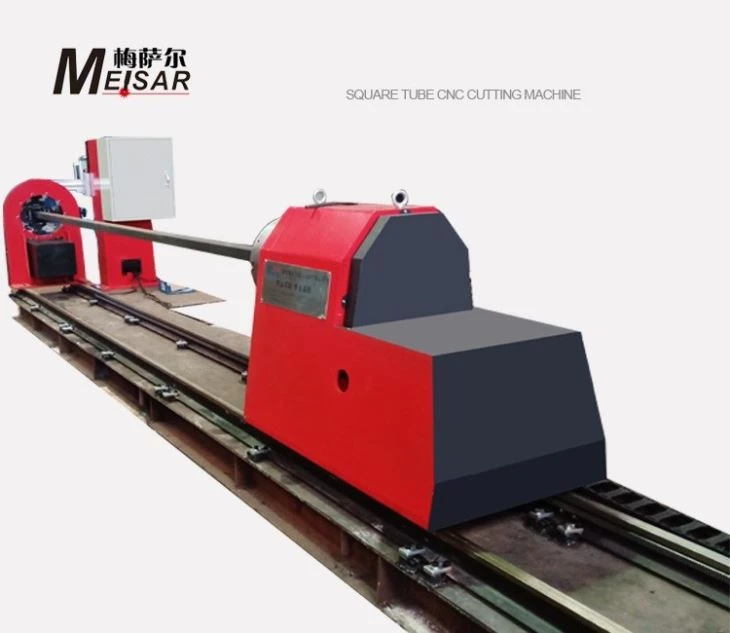
Heavy structural steel fabrication and pressure vessel manufacturing require repeatable, code-compliant weld preparation on tubular nodes. This CNC Pipe Profile Cutting Machine utilizes multi-axis interpolated motion to execute complex contours, miters, saddles, and bevels in a single pass, eliminating manual layout and secondary grinding.
Standard Technical Specifications
|
Model Series |
PC-600 |
PC-1000 |
PC-1500 |
|
Pipe Diameter Range |
OD 50 to 610 mm |
OD 60 to 1000 mm |
OD 200 to 1500 mm |
|
Max Wall Thickness |
Plasma: 25 mm / Oxy-fuel: 60 mm |
Plasma: 32 mm / Oxy-fuel: 100 mm |
Plasma: 50 mm / Oxy-fuel: 200 mm |
|
Supported Pipe Length |
6 m / 12 m (Customizable) |
6 m / 12 m (Customizable) |
6 m / 12 m (Customizable) |
|
Controlled Axes |
4-Axis (X, Y, Z, A) or 5-Axis (X, Y, Z, A, W) |
4-Axis or 5-Axis |
4-Axis, 5-Axis, or 6-Axis |
|
Rotary Chuck Type |
Pneumatic Self-Centering 3-Jaw / Roller Bed |
Heavy-Duty Roller Bed with Anti-Drift |
Heavy-Duty Hydraulic/Pneumatic Clamping |
|
Positional Accuracy |
+/- 0.1 mm |
+/- 0.1 mm |
+/- 0.15 mm |
|
Cutting Technologies |
Air Plasma, High-Definition Plasma, Oxy-Fuel |
High-Definition Plasma, Oxy-Fuel |
High-Definition Plasma, Oxy-Fuel, Laser Option |
Machine Architecture & Manufacturing Standards
Mechanical Bed & Loading System
• Bed Construction: Welded heavy-gauge structural steel tubing, stress-relieved via high-temperature annealing (600 degrees Celsius for 12 hours) to eliminate residual welding stresses prior to precision machining.
• Guide Rails: Linear guide rails matched with hardened helical rack and pinion drives on longitudinal axes, delivering backlash-free motion transfer.
• Chuck Assembly: Self-centering pneumatic chucks or adjustable roller beds equipped with polyurethane-coated support rollers to prevent surface marring on stainless steel and alloy pipe grades.
Torch Motion & Bevel Control
• Axis Configuration:
4-axis models control longitudinal travel (X), torch vertical stroke (Z), pipe rotation (A), and torch cross-axis movement.
5/6-axis configurations add continuous torch tilt (rotation around horizontal and vertical axes) to generate precise weld bevel profiles (V, Y, K, and X bevels) up to +/- 45 degrees for plasma and +/- 60 degrees for oxy-fuel.
• Torch Height Control (THC): Integrated capacitive/arc-voltage automatic torch height control maintains a constant standoff distance from the pipe surface, compensating for out-of-roundness and thermal distortion.
• Collision Protection: Magnetic breakaway torch mount prevents mechanical damage if a tip-up occurs during cutting.
Control System & Software Integration
• CNC Controller: Industrial PC-based CNC running a real-time operating system with a dedicated macro library for standard pipe joints (T, Y, K connections, gusset slots, and saddle cuts).
• Nesting & Programming: Compatible with standard CAD/CAM and pipe profiling software (such as SigmaNEST, ProNest, and Tekla). Direct import of .STEP, .IGES, and .NC files.
• Interface: 19-inch industrial touchscreen with remote diagnostic capability via Ethernet and USB program transfer.
Application Matrix & Material Compatibility
This equipment processes carbon steel, alloy steel, stainless steel, aluminum, and nickel alloys across heavy industries:
Offshore Oil & Gas:
Jacket nodes, platform bracing, and high-pressure subsea piping systems requiring stringent weld root clearance.
Pressure Vessels & Boilers:
Header pipe fabrication, nozzle penetrations, and shell-to-pipe intersections compliant with ASME Section VIII.
Structural Steel & Construction:
Stadium roofs, bridge trusses, architectural columns, and complex tubular nodes.
Process Piping & Petrochemical:
Skids, manifolds, and high-integrity piping networks.
Quality Control & Inspection Protocol
Every machine undergoes strict dimensional and functional verification before factory release:
Bed Geometry Inspection: Laser interferometer calibration measuring linear axis straightness, parallelism, and squareness over full travel lengths.
Rotational Runout Test: Dial indicator verification of chuck concentricity and axial runout under loaded conditions.
Motion Interpolation Test: Dry-run execution of complex intersecting saddle cuts to verify multi-axis synchronization and contour smoothness.
Gas & Electrical Safety Check: Pressure testing of all pneumatic/gas distribution lines; insulation resistance and high-potential (Hi-Pot) testing of electrical panels.
Evaluation & Procurement Guide
When comparing pipe profiling machinery, evaluate technical criteria against your shop requirements:
Check Drive Mechanics: Insist on planetary gearboxes with low backlash ratings (under 3 arcminutes) on rotary axes to prevent contour distortion on large-diameter pipes.
Verify Software Post-Processors: Confirm whether the supplier provides open post-processors or proprietary software that locks you into their ecosystem.
Assess Gas Supply Stability: Ensure the plasma or oxy-fuel manifold capacity matches the maximum wall thickness you process regularly, avoiding pressure drop during extended cuts.
Evaluate Support Logistics: Check consumable availability (nozzles, electrodes, shields) and local technician response times for controller troubleshooting.
Frequently Asked Questions
Q: How does the machine handle out-of-round (ovality) or bent pipes?
A: The system combines automated capacitive/arc-voltage torch height control (THC) with floating sensor heads. As the pipe rotates, the Z-axis dynamically adjusts in real time to compensate for ovality deviations up to standard mill tolerances, maintaining consistent focal distance and bevel angle.
Q: What is the transition time between loading different pipe diameters?
A: Pneumatic self-centering chucks allow diameter adjustments to be executed via preset software parameters or quick-clamp mechanisms, typically reducing setup changeover time to under 3 minutes without manual wrench adjustments.
Q: Can the machine integrate with existing factory material handling systems?
A: Yes. The machine bed interfaces with inbound V-type step-loaders, cross-transfer chain conveyors, and outbound sorting tables through discrete I/O signals or Ethernet-based PLC handshakes.
Q: What plasma power sources are compatible with the machine interface?
A: The CNC controller integrates with major industrial plasma systems, including Hypertherm Powermax and HyPerformance series, as well as Kjellberg HiFocus systems, communicating via digital RS-485 or hardwired analog signals for current, gas pressure, and flow control.
Request Technical Proposal & Quotation
To generate a precise technical and commercial proposal for your facility, please provide the following parameters:
• Minimum and maximum pipe outer diameter (OD) and wall thickness.
• Maximum single-pipe length and weight capacity.
• Material grades processed (e.g., carbon steel, stainless steel).
• Required cutting technology (High-definition plasma or oxy-fuel).
• Desired axis configuration (4-axis vs. 5/6-axis bevel cutting).
[Request Specification Sheet & Quotation] (Button)
Hot Tags: cnc pipe profile cutting machine, China cnc pipe profile cutting machine manufacturers, suppliers, factory