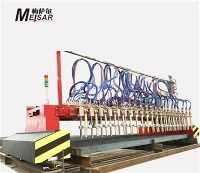
CNC Pipeline Beveling and Cutting Machine
Precision pipe end preparation for heavy-wall industrial fabrication. Engineered for automated, repeatable weld-prep geometry on carbon steel, stainless steel, and alloy pipelines.
Technical Overview & Core Specifications
Modern code-compliant welding requires strict dimensional accuracy at the pipe joint. This CNC pipeline beveling and cutting machine integrates a rigid structural steel gantry or split-frame clamping assembly with closed-loop servo drives, delivering uniform thermal-free or mechanical chip removal across heavy-wall profiles.
[Visual Asset Placeholder: CAD cutaway showing the multi-axis servo drive assembly and rigid split-frame clamping mechanism]
Standard Specification Matrix
|
Parameter |
Metric Specification |
Imperial Specification |
|
Pipe OD Clamping Range |
168 mm - 1220 mm |
6 in - 48 in (Custom engineering up to 80 in) |
|
Max Wall Thickness |
Up to 100 mm |
Up to 3.94 in (Custom up to 150 mm) |
|
Bevel Angle Range |
0° - 45° (Adjustable increments: 0.1°) |
0° - 45° |
|
Drive Power |
15 kW - 37 kW (AC Servo / Planetary Gearbox) |
20 HP - 50 HP |
|
Spindle Speed Range |
5 RPM - 65 RPM (Variable Frequency) |
5 RPM - 65 RPM |
|
Control System |
Industrial CNC (Multi-axis interpolation / PLC) |
Industrial CNC |
|
Drive Mechanism |
Precision rack and pinion with preloaded ball screws |
Rack and pinion / Preloaded ball screws |
Product Selection Guide
Selecting the correct configuration depends on pipe metallurgy, dimensional envelopes, and shop floor constraints. Evaluate these parameters before requesting a quote:
Dimensional Envelope:
Determine minimum and maximum Outside Diameters (OD) and maximum wall thickness. Ensure the clamping jaw range accommodates standard and outlier pipe sizes. Custom multi-radius jaw packages are available for non-standard pipe schedules or out-of-round structural tubes.
Material Metallurgy:
Processing high-nickel alloys, duplex stainless steels, or heavy-wall API 5L X80 carbon steel requires higher torque ratings, rigid tool holders, and tailored cutting speeds to prevent work hardening.
Bevel Geometry Requirements:
Standard V-grooves require basic single-axis feed. Complex pressure vessel codes (ASME Section VIII) often demand compound J-prep or U-prep contours requiring multi-axis CNC interpolation.
Integration Format:
Choose between stationary shop-floor roller-bed configurations for high-volume spool prefabrication or portable split-frame configurations for in-field tie-ins and existing rack modifications.
Industrial Applications
Oil & Gas Transmission: Processing high-strength API 5L line pipes (X60 to X100) prior to mainline automatic girth welding.
Petrochemical & Refining: Machining thick-wall chrome-moly alloy steel (P91/P22) for high-temperature, high-pressure reactor piping.
Power Generation: Fabricating nuclear and thermal power plant secondary loops requiring strict root-gap tolerances and non-destructive testing (NDT) clearance.
Shipbuilding & Offshore: Preparing structural tubular members and risers where dimensional out-of-roundness must be corrected mechanically prior to fit-up.
Engineering & Manufacturing Verification
Reliability stems from controlled manufacturing protocols and rigorous dimensional inspection.
Structural Rigidity: Base frames are fabricated from stress-relieved structural steel plates, precision-machined on heavy floor-type boring mills to eliminate harmonic vibration during heavy material removal rates.
Drive Train Assembly: Utilizes hardened alloy steel gears and precision ground helical racks, inspected via laser interferometers to guarantee backlash under 0.03 mm.
Electrical and Control Architecture: Enclosures built to IP54 standards. Electrical systems comply with regional international standards, supporting CE, UL-listed components, and CSA conformity to clear local plant safety pre-qualifications.
Factory Acceptance Testing (FAT): Every unit undergoes a 72-hour continuous no-load run test followed by a live material test cut on a 12 mm wall carbon steel pipe sample. Circularity, root face thickness, and angular tolerance are verified using calibrated coordinate measuring instruments (CMM) and optical comparators prior to crating.
Supplier Evaluation Criteria (Why Partner With Us)
Procuring capital equipment requires verifiable manufacturing capabilities rather than marketing promises.
Direct Manufacturing: In-house fabrication shops equipped with CNC plasma cutters, large-format annealing furnaces, and CNC gantry milling machines control production lead times and structural quality.
Traceability: Raw material mill test certificates (MTCs) for structural plates and forged spindle shafts are archived and supplied in the permanent documentation package.
Engineering Transparency: Comprehensive technical manuals, electrical schematics, hydraulic diagrams, and spare parts breakdown lists are delivered standard with every machine.
Global Logistics & Support: Crating complies with ISPM 15 export standards. Direct engineering-desk backup via secure industrial ethernet guarantees remote diagnostic support within 4 hours across time zones.
Frequently Asked Questions
Q: What is the typical setup and clamping time for different pipe diameters?
A: Clamping and centering a standard 24 in pipe using hydraulic or self-centering mechanical jaws takes approximately 3 to 5 minutes. Tooling changeovers for different bevel angles take under 10 minutes utilizing quick-change indexable carbide insert holders.
Q: Can this machine handle out-of-round (oval) pipes common in heavy-wall fabrication?
A: Yes. The floating tracking mechanism and adaptable clamping profile compensate for standard manufacturing ovality. For severe out-of-round conditions, multi-point proportional clamping jaws can be configured to maintain consistent standoff distance between the cutting edge and the pipe surface.
Q: What cutting tools are required, and how are chip loads managed?
A: The machine utilizes standard ISO indexable carbide inserts mounted in custom modular tool blocks. For high-volume carbon steel cutting, TiAlN-coated inserts are recommended. Continuous chip evacuation is handled via built-in chip collection chutes or optional magnetic conveyor integration.
Q: What utility requirements are needed on the shop floor?
A: Standard electrical supply requires 380V/415V/480V, 3-phase, 50/60Hz (custom multi-tap transformers and CE/UL/CSA compliant panels available upon request). Compressed air at 0.6 MPa - 0.8 MPa is required if pneumatic clamping or cooling mist options are specified.
Request Technical Proposal & Quotation
To evaluate compatibility with your specific production requirements, provide the following parameters when submitting an RFQ:
• Pipe material grade, OD range, and wall thickness.
• Required bevel configurations (V, X, J, U).
• Target destination standards (e.g., CE, UL, CSA requirements) and production output targets.
[Submit Technical RFQ / Contact Engineering Team]
Hot Tags: cnc pipeline beveling and cutting machine, China cnc pipeline beveling and cutting machine manufacturers, suppliers, factory